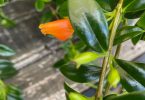
I have a favourite street tree. The Water Gum (Tristaniopsis laurina) is flowering around Sydney as I write this and those little yellow clusters are a very good excuse to slow down on a walk. The glossy leaves usually get my attention first. Then there’s the peeling bark, the shade and if you get close enough, the bees working their way through the flowers.
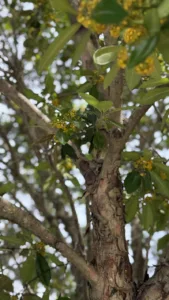
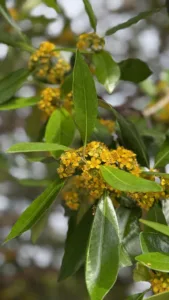
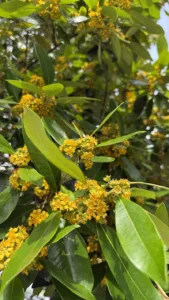
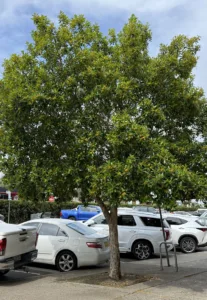
Also called Kanooka, Water Gum is an Australian native evergreen that grows naturally along streams and in forests from south-eastern Queensland through New South Wales to eastern Victoria. It’s a familiar sight on Sydney streets and can make a lovely shade tree at home if you have space for the canopy and can give it a decent drink through dry weather.
How To Recognise A Water Gum
Look for long, glossy leaves with dark green tops and much paler undersides. On a breezy day you can see the two colours as the leaves turn. Look lower down and you’ll often find pale bark lifting in strips or flakes, leaving a patchwork of colour on the trunk. The bark on younger trees tends to be smoother.
The flowers are small, with five rounded petals, and sit together in short clusters among the leaves. From across the road they can be easy to miss. Up close you can see the little bundles of stamens in the middle of each flower. Woody seed capsules follow the blooms and are another clue when you’re trying to identify a tree out of flower.
| Feature | Details |
|---|---|
| Botanical name | Tristaniopsis laurina |
| Common names | Water Gum, Kanooka |
| Plant type | Australian native evergreen tree |
| Garden height | About 5–15 m for the species in cultivation. Size varies by site and form. |
| Position | Full sun to light shade |
| Soil | Moist and well drained |
| Flowering | Yellow clusters, mainly in Summer. Some Sydney trees start in Spring. |
| Best use | Street tree, garden feature or evergreen shade tree |
When Does Water Gum Flower?
Water Gum is generally a Summer flowerer. Many people record flowering in December and January, though Northern Beaches Council lists Spring flowering locally. I’m already seeing flowers in late November here in Sydney.
If you’ve got a tree you pass regularly, start looking in late Spring and keep checking as Summer gets underway. The timing can vary between sites and forms. The yellow flowers attract bees and have a mild honey-like scent.
How To Grow Water Gum
Choose A Site With Room For Shade
Give it full sun or light shade and soil that holds some moisture while still draining. Water Gum can grow in a range of soils, including clay loam, where drainage and moisture are suitable. Before planting, look up for overhead services and check what’s below ground. Then think about where the canopy will sit in ten years. Dense evergreen shade can be lovely over a lawn or seating area and frustrating beside a veggie patch or a window you rely on for Winter sun.
Water Well While It Settles In
Plant with the top of the root ball level with the surrounding soil and water it in well. During the first Summer, check the soil at the edge of the root ball, especially after hot or windy days. Give it a slow, thorough soak when it starts to dry. Spread a layer of coarse organic mulch over the surrounding soil and leave a clear gap around the trunk. Chipped branches from a recent pruning job can do the job if the material is healthy and free of weeds.
Keep Pruning Light
For a shade tree, give the canopy room to develop its natural shape. On a young tree, a little formative pruning can help if branches are crossing or competing for space. Keep an eye out for scale on the stems and leaves. A few marked leaves or chewed edges are usually something I’d watch first, especially while the flowers are busy with bees.
If you have a sunny patch to spare, the seed collection in The Curious Gardener Shop includes culinary herbs you can leave to flower for visiting insects.
Water Gum And Luscious® Water Gum
The straight species already has glossy foliage and an attractive trunk. Luscious® Water Gum is a named selection (Tristaniopsis laurina ‘DOW10’), with broader leaves, coppery new growth and a denser canopy. It’s used as a street tree around Sydney, including in the City of Parramatta.
If you’re buying one for home, allow for around 7–12 m in height and 3–5 m in spread as a guide, with room for variation. The dense foliage is the reason I’d choose it for a spot where shade is the whole point of planting a tree.
For another east-coast native with a different look, have a peek at Blueberry Ash, which has fringed flowers and bright blue fruit.
Next time you walk past a Water Gum in flower, look for a low branch and take a minute to see what’s visiting. Then have a look at the bark on the way past. By then you’ll probably understand why it’s my favourite street tree. 💛
Water Gum FAQs
How Tall Does A Water Gum Grow?
In cultivation, the Australian National Botanic Gardens gives a height of about 5–15 m for the species. Some plantings stay smaller, while trees in their natural habitat can grow considerably taller. If you’re planting near a boundary, plan for the upper end of the range given for the form you’re buying.
Can You Grow Water Gum In A Pot?
You can grow one in a large container, but I’d treat it as a young tree you may eventually need to move into the ground. Use a stable pot with drainage holes and check it often in warm weather. For a small courtyard where the pot will be its permanent home, I’d choose a naturally smaller plant.
Is Water Gum Drought Tolerant?
Established trees can cope with dry weather, but Water Gum grows best with reliable moisture. Give young trees close attention through hot spells and be prepared to water established trees in extended dry periods, particularly on exposed sites.
Is Water Gum Good For Bees?
Yes. Its flower clusters draw bees and are easy to watch on branches that hang low enough to see from the footpath. If you’re planting for pollinators at home, add native flowers that attract bees and other beneficial insects at other times of year too.