There are flowers that gently blend into the garden and then there are Billy Buttons. These cheerful golden spheres sit proudly on tall stems as though someone has dotted the garden with tiny yellow lollipops.
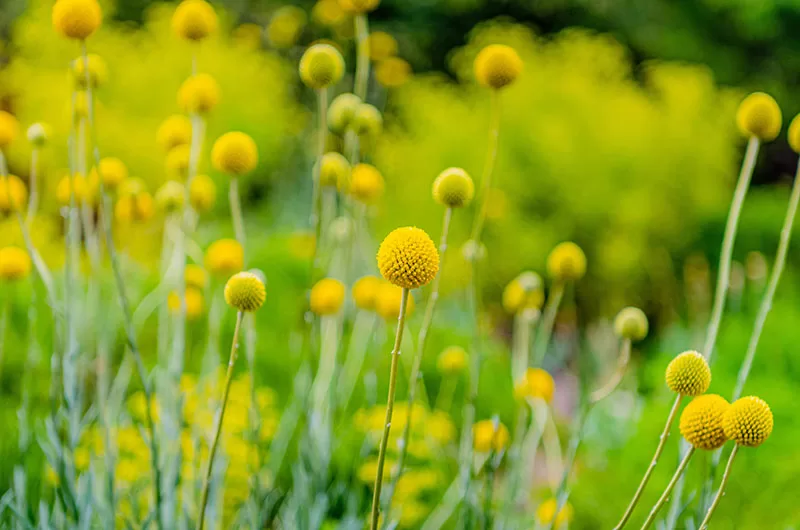
Pycnosorus globosus is an Australian native perennial with silvery foliage and unmistakable globe-shaped flowers. It brings colour, shape and a slightly quirky personality to native gardens, cottage gardens, rockeries and pots.
The flowers are also excellent for cutting and drying. They hold their shape beautifully which explains why Billy Buttons appear so often in native bouquets and everlasting arrangements.
Why you’ll love it
- Distinctive golden ball-shaped flowers that look good from every angle
- Tall upright stems that add height without creating a bulky plant
- Soft silvery-grey foliage that contrasts beautifully with green plants
- Flowers attract bees, butterflies and other beneficial insects
- Suitable for native gardens, cottage gardens, rockeries and containers
- Excellent as a fresh or dried cut flower
- Tolerates different soil types including heavier soils
- Tolerates light frost and is reasonably drought tolerant once established
Botanical name
Pycnosorus globosus
This plant was previously known as Craspedia globosa and was renamed in 1992, so you may still find it sold or mentioned under its former botanical name. It’s worth knowing that a few true Craspedia species also go by “Billy Buttons,” so the names are sometimes used loosely. The two genera look similar but differ in the flower head: in Pycnosorus the tiny flowers sit directly on the head, while in Craspedia they’re held on little stalks.
Common name
Billy Buttons, Drumsticks
Billy Buttons description
Billy Buttons is a clumping perennial that grows from a persistent rootstock. It produces a mound of narrow silvery-grey leaves covered in fine woolly hairs. The foliage generally remains fairly low while the sturdy flower stems rise well above the plant.
Each golden flower ball is more intricate than it first appears. What looks like a single bloom is actually a compound head packed with as many as 70 to 200 smaller partial heads, each holding a few tiny flowers. Together they form the dense, perfectly round sphere that gives the plant its charm. The rounded heads usually measure between 8 and 35 mm across and appear on mostly unbranched stems.
Most plants sit somewhere in the 40 cm to 1 metre range, though in good conditions the flower stems can reach up to 1.2 metres tall. The overall effect is wonderfully architectural. The long stems seem to float above the foliage while the perfectly round blooms bring strong colour and repetition to a planting scheme.
Flowering generally occurs from early Spring through Summer. Removing older flower heads may encourage the plant to produce further blooms and keeps the clump looking tidy.
Climate
Billy Buttons naturally occur in Queensland, New South Wales, Victoria and South Australia. They are particularly well suited to cool temperate, warm temperate and Mediterranean climates.
The plant tolerates light frost and can handle periods of dry weather once it has established. It tends to perform best where Summers are not excessively humid.
Gardeners in warmer or humid areas should provide excellent airflow and avoid planting where water will sit around the crown for long periods.
Plant cultivation & care
Light
Billy Buttons flower best in full sun. They can tolerate light shade although fewer flowers and softer stems may result when the plant does not receive enough direct sunlight.
A sunny position also helps keep the foliage compact and encourages the strong upright stems that make this plant so distinctive.
Soil
This is where Billy Buttons become slightly more interesting.
In the wild they are often found growing in open, low-lying areas and heavier soils that are seasonally wet and sometimes flooded over Winter. In the garden they prefer moist soil with reasonable drainage rather than permanently wet or stagnant conditions.
They can grow in:
- Clay soil
- Clay loam
- Sandy loam
- Loamy soil
- Quality native potting mix
Avoid burying the crown beneath thick mulch as trapped moisture can encourage decline. Leave a little breathing room around the base of the plant.
Watering
Water regularly while the plant is establishing. Billy Buttons appreciate consistent moisture during active growth and flowering although the soil should not remain soggy.
Once established they can tolerate some dry periods. Flowering is generally better when plants are watered during extended hot or dry weather.
Plants growing in pots will dry out more quickly than those in garden beds so check them regularly during Spring and Summer.
Feeding
Billy Buttons are not particularly demanding when it comes to fertiliser.
Apply a light dose of controlled release fertiliser formulated for Australian native plants in Spring. Avoid excessive feeding as this may encourage soft leafy growth at the expense of flowers.
Container-grown plants may benefit from an occasional gentle liquid feed during the growing season.
Growing Billy Buttons in pots
Billy Buttons can grow successfully in containers although the pot needs to be deep enough to accommodate the plant’s root system.
Choose a container with generous drainage holes and fill it with a quality native potting mix. Adding coarse sand or perlite can improve drainage if the mix feels heavy.
Place the pot in full sun and avoid allowing it to sit in a saucer filled with water. Given plenty of sunlight and a deep, free-draining pot, they reward you handsomely for the small amount of effort.
Propagation
Billy Buttons can be propagated from seed or cuttings. Established clumps may also gradually expand from the base over time.
Cuttings generally root readily and quickly when taken from healthy growth. Seeds can be sown into a fine seed-raising mix and kept lightly moist while germinating, with germination usually taking around two to three weeks.
Avoid covering the seed too deeply. Once seedlings are large enough to handle they can be carefully transferred into individual pots.
Plant Use
Billy Buttons are surprisingly versatile despite their unusual appearance.
Use them in:
- Australian native gardens
- Cottage-style gardens
- Rockeries and gravel gardens
- Coastal gardens
- Sunny courtyard gardens
- Pots and deep containers
- Mass plantings
- Cut flower gardens
- Pollinator-friendly gardens
They look particularly effective when planted among native grasses, Kangaroo Paws, Paper Daisies, Everlasting Daisies and low-growing groundcovers.
The round flower heads provide a strong contrast against fine foliage and softer flower forms. Plant several together rather than scattering single plants around the garden. A small group creates far more impact when the flowers begin bobbing above the foliage.
Billy Buttons also make wonderful cut flowers. Pick the stems when the flower heads are fully coloured and place them in a vase with or without water depending on whether you want a fresh or dried arrangement.
For drying, tie a small group of stems together and hang them upside down in a cool dry place away from direct sunlight. The flower heads retain their shape and colour remarkably well.
Pruning
Billy Buttons do not need complicated pruning.
Remove spent flower stems at the base once flowering has finished. This tidies the plant and directs energy back into the foliage and rootstock.
Older foliage can be trimmed back when it becomes untidy or begins to die down. Avoid cutting into fresh central growth.
Regularly picking flowers for the vase also acts as a form of deadheading and may encourage further blooms. Finally, a plant that rewards you for taking flowers inside. Very civilised.
Pests & diseases
Billy Buttons are generally resilient and are not known for attracting a long list of pest problems.
Snails and slugs may occasionally chew young growth while aphids can appear on developing flower stems. These problems are usually minor and can be managed by checking plants regularly.
The main concern is poor drainage. Constantly wet conditions around the crown may lead to root or crown rot. Good airflow, sensible watering and a position that does not remain waterlogged will prevent most problems.
Avoid piling organic mulch directly against the centre of the plant.
The flowers attract bees, butterflies and other insects which makes Billy Buttons a valuable addition to a wildlife-friendly garden.
In Summary
Pycnosorus globosus is a distinctive Australian native perennial with silvery woolly foliage and bright golden flower balls held on tall upright stems.
It grows best in full sun with moist but reasonably well-drained soil. Once established it can tolerate light frost and periods of dry weather. It suits native gardens, cottage gardens, rockeries, coastal gardens and deep containers.
Billy Buttons bring colour, structure and a little bit of garden theatre without taking themselves too seriously. They are excellent for pollinators and the flowers can be enjoyed fresh in a vase or dried for arrangements that last for years.
What more could you ask from a cheerful yellow ball on a stick?
Planning to add Billy Buttons to your garden? Our Australian made Garden Hand Tool Combo Pack makes planting and soil preparation easier while our compostable Repotting Mats help contain the inevitable potting mix explosion when growing them in containers.
Once the planting is done, the Activated Charcoal and Pumice Gardener’s Soap will tackle the dirt that somehow ends up under every fingernail.
FAQs – Pycnosorus globosus – Billy Buttons
Most plants sit in the 40 cm to 1 metre range, with the flower stems rising well above the low mound of foliage. In good conditions the stems can reach up to 1.2 metres, so give them a spot where a little height is welcome.
Yes. Pycnosorus globosus is a perennial, growing from a persistent rootstock that returns each season. Removing spent flower stems at the base once flowering finishes helps direct energy back into the plant for the following year.
They grow happily in containers as long as the pot is deep enough for their roots and has generous drainage holes. Use a quality native potting mix, place the pot in full sun, and never let it sit in a saucer of water. Pots dry out faster than garden beds, so check them regularly through Spring and Summer.
Pick the stems once the flower heads are fully coloured, tie a small bunch together, and hang them upside down in a cool, dry place away from direct sunlight. The heads hold their shape and golden colour remarkably well, which is why they’re a favourite in everlasting arrangements.